Showing posts with label Hybridization. Show all posts

Monday, August 25, 2014

Effect of Lone Pairs on Hybridization


We have discussed the effect of ghost lone pairs on the shape of a molecule in the post about VSEPR theory. The effect lone pairs exert is the same in VBT as it was in VSEPR. In this post we will study a few examples in which central atom possess lone pairs.

First, we will take the example of NH3 molecule. When you draw its Lewis dot structure, you will find three bonding pairs of electrons and one lone pair on N. Now write the ground state configuration of N.

7N: 1s2, 2s2, 2p3

N already has 3 unpaired electrons in ground state to make bond with 3 H atoms.  You may think why does N need hybridization in this case when it has 3 unpaired electrons of the same orbital p? Because hybridized orbitals are more competent in overlapping which results in a stronger bond.

In NH3 molecule, N chooses sp3hybridization. This may get you puzzled again, if N has 3 unpaired electrons in p why does it include s orbital which has paired electrons? You know that the atoms follow Hund’s rule for filling electrons in orbitals, similarly they have to consider energy order of orbitals in hybridization also. When an atom undergoes hybridization, it has to pick orbitals in the increasing order of their energies. In NH3, N has to first pick 2s then 2px, 2pyand then 2pz. N can’t ignore 2s even if it is filled because 2s has the lowest energy and N has to include all three 2porbitals because it needs them for bonding with three H atoms.


Pyramidal shapeNow four sp3 hybridized orbitals get arranged in tetrahedral shape. One sp3orbital is occupied by lone pair and other three are used for making sigma bond with 1s orbitals of three H atoms.
We have already studied that lone pairs are like aloof ghosts; they repel bonding pairs and decrease the bond angles. In NH3 molecule, the lone pair repels bonding pairs, compresses them and distorts the tetrahedral shape to pyramidal shape.

Let’s take another example of H2O molecule. Write the ground state configuration of O

8O: 1s2, 2s2, 2p4

You will find that O has 2 unpaired electrons. As I have explained earlier, O will also choose hybridization for stronger bonding. It has to include s, px with py and pz, thus it gets 4 sp3hybridized orbitals. Out of 4 sp3hybridized orbitals 2 are occupied by lone pairs and 2 are used for sigma bonding with 1s of two H atoms. Here 2 lone pairs make a large distortion of tetrahedral shape which results in bent shape of H2O molecule.
bent shape
We have studied molecules which have pi and sigma bonds and molecules which have sigma bonds and lone pairs. Now we will take an interesting molecule SO2, which has both sigma and pi bonds as well as lone pair of electrons. Let’s see how all of them affect the shape and hybridization of molecule.

Write the ground state configuration of S
16S: 1s2, 2s2, 2p6, 3s2, 3p4

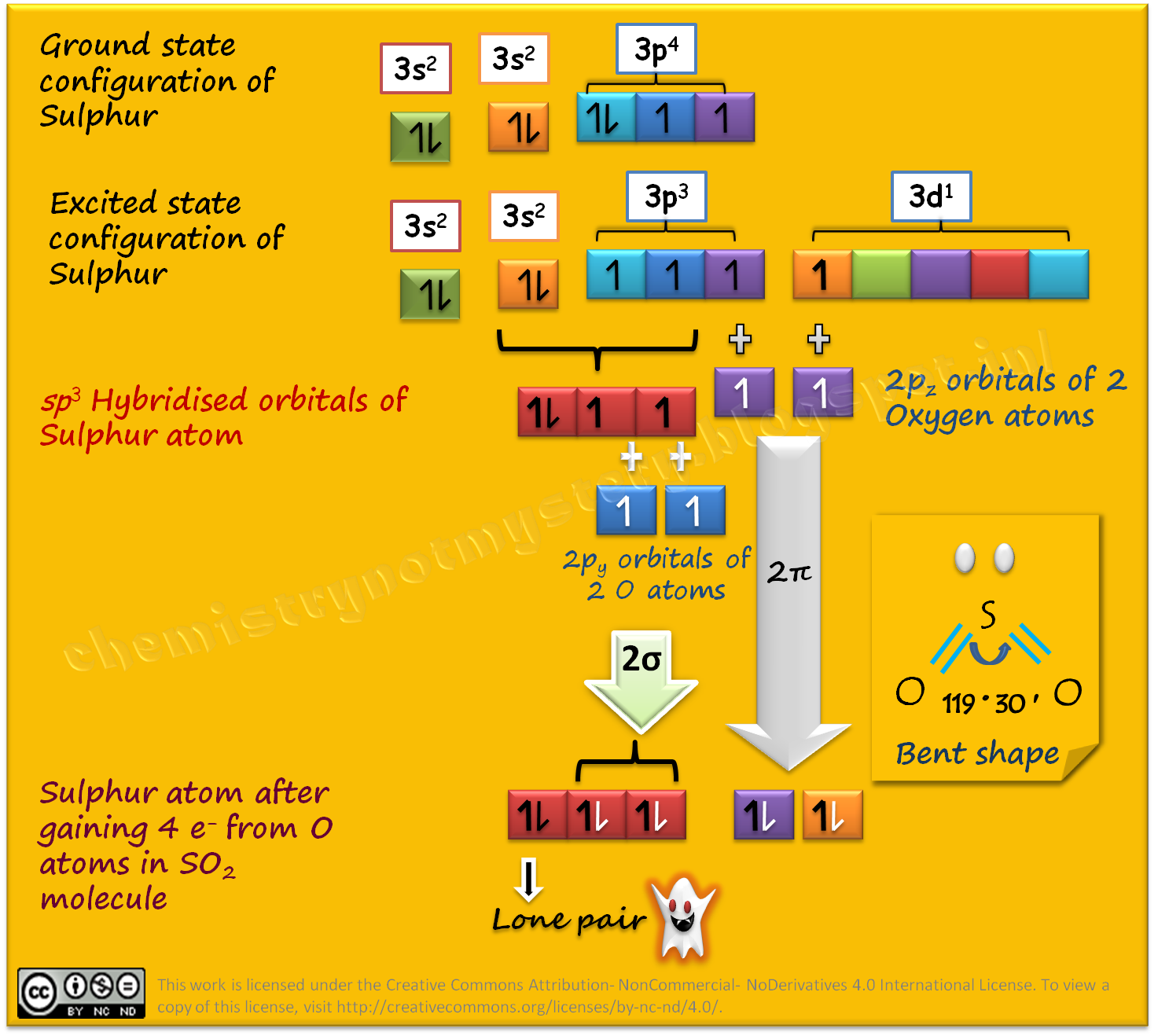
S has 2 unpaired electrons but it needs 4 unpaired electrons, 2 for making 2 sigma bonds and 2 for making 2 pi bonds. So it excites one of the paired electron of px orbital and promotes it to the next orbital (d), it’s excited state configuration becomes:

16S: 1s2, 2s2, 2p6, 3s2, 3p3, 3d1

Here you may get confused again, when the energy of 4s is lesser than 3d, why does S promote its electron to 3d? Because S wants to get its atomic orbitals hybridized and to do so it has to make sure that all the orbitals must belong to the same orbit, so that they have comparable energies.
S chooses 3s, 3pxand 3py for hybridization and gets three sp2hybridized orbitals. One of the three is occupied by a lone pair and remaining two are used for sigma bonding with 2pyof O atoms. S leaves two orbitals free for pi bonding; its 3pz orbital makes pi bond with 2pz of one O atom and 3dxz makes pi bond with 2pz of the other O atom.

Three sp2 hybridized orbitals of S arrange themselves in triangular shape but the ghost lone pair doesn't sit silently. It creates disturbance as usual and distorts the shape to bent shape and compresses OSO angle from ideal 120° to 119°30′.

Pi bonds do not interfere with the shape and bond angle of the molecule. But their presence shortens the bond length because they pull the bonded atoms closer for sidewise overlapping.
In SO2 molecule the two sigma bonds are identical as they are formed by overlapping with sp2 hybridized orbitals but what about pi bonds? One pi bond is formed by overlapping of 3pz-2pz and other is formed by 3dxz-2pz. Are they identical? Is it justified? In the world of atoms, there is no discrimination and everything is quite justified. We will see their unbiased and impartial behavioural aspect in our coming posts. In the next post we will see what is the advanced theory known as MOT (Molecular Orbital Theory) which solves the mystery of molecules.


This work is licensed under the Creative Commons Attribution- NonCommercial- NoDerivatives 4.0 International License. To view a copy of this license, visit http://creativecommons.org/licenses/by-nc-nd/4.0/.

Friday, August 22, 2014

Hybridization: In molecules containing double and triple bond.


We have discussed hybridization in the molecules which have single bonds, in this post we will see how double and triple bonds are formed and how do they affect the hybridization. Hybridization is a phenomenon which is extensively used in the study of Carbon compounds. When I start my posts on organic chemistry, we will discuss different Carbon compounds and to understand their behaviour you will need to know which type of hybridization they undergo. That’s why I have created this post to give you just an idea about the role of hybridization in Carbon compounds and here we will learn hybridization through the example of H-CO-H molecule.
head on overlapping
Try to draw H-CO-H molecule's Lewis dot structure and Kekule’s structure. In this molecule C forms single bond with each H and double bond with the O atom. I have told you that double bond is formed by two covalent bonds and denoted as two parallel dashes. But these two bonds are not identical because they are formed by different procedures. Let’s see how they are formed.

In the previous post you have learnt that a bond is formed by overlapping of orbitals. If I ask you to demonstrate this procedure with your hand how will you connect your hands? Some of you may try to connect your hands by touching the tips of your fingers and some of you may try to connect them side-wise, your palms facing each other. 

Bonding orbitals also have two ways to overlap with each other. When orbitals form a bond by head on overlapping, they form a sigma (σ) bond, it is also called the single bond. When orbitals form a bond by side-wise overlapping they form a pi (π) bond. A double bond is formed by one sigma and one pi bond.

side wise overlappingLet’s see how H-CO-H molecule is formed. Write the electronic configuration of H, O and C.

1H : 1s1
8O : 1s2, 2s2, 2p4
6C : 1s2, 2s2, 2p2

C needs four unpaired electrons to make bonds with H and O. So it promotes its one of the paired electrons of s orbital to the empty p orbital. Now its excited state configuration will become:

6C : 1s2, 2s1, 2p3

In H-CO-H molecule C forms 2 sigma bonds with H atoms and 1 sigma bond and 1 pi bond with O atom. If C chooses sp3 hybridization then all four hybridised orbitals will be pointed towards the corners of a tetrahedron. Two of them can make head on overlapping to form sigma/single bond with two H atoms. Remaining 2 will be used for bonding with O. C has to make one sigma bond and one pi bond with O. It can manage one head on overlapping but it is impossible to do side-wise overlapping in this spatial condition.
That’s why C plans a different way, it chooses one s and two p (pxand  py) orbitals and hybridise them to get three sp2hybridised orbitals. These three orbitals are arranged in a triangular shape. This way C has the remaining unhybridised pzorbital perpendicular to the triangle and now it is available for the side-wise overlapping. That’s how in H-CO-H molecule C manages to form three sigma bonds by using three sp2hybridised orbitals and forms one pi bond by using unhybridised pz orbital.


Now take another example of HCN molecule. In this molecule C forms triple bond with N and single bond with H atom. Triple bond is formed by 1 sigma and 2 pi bonds. Let’s see how smartly C uses hybridization to form 2 pi and 2 sigma bonds.
C has 4 unpaired electrons in excited state. It uses only two orbitals for hybridization to form 2 sigma bonds and leaves 2 orbitals free for sidewise overlapping to form 2 pi bonds.

C chooses s and pxorbital and hybridise them to get two sp hybridised orbital. One sp hybridised orbital forms sigma bond through head on overlapping with s orbital of H and other sp hybridised orbital forms sigma bond through head on overlapping with px orbital of N. Now C has 2 unhybridised orbital py and pz ­, it uses them for sidewise overlapping with py and pz ­orbitals of N respectively to form 2 pi bonds.

In the next post we will see how lone pairs affect the hybridization.


This work is licensed under the Creative Commons Attribution- NonCommercial- NoDerivatives 4.0 International License. To view a copy of this license, visit http://creativecommons.org/licenses/by-nc-nd/4.0/.

Tuesday, August 19, 2014

sp2 and sp Hybridization

Today we will discuss the formation of Boron trifluoride BF3 molecule. Let’s write the ground state configuration of central atom B and F.

5B – 1s2, 2s2, 2p1
9F – 1s2, 2s2, 2p5

Hybridization of BF3B needs 3 unpaired electrons or you can say it needs 3 hybridised orbitals to make bonds with 3 atoms of F. That’s why B supplies some energy to 2s to lifts it to the level of 2p. In this way one of the paired electron of 2s jumps to the vacant orbital of 2p. Now this excited state has the following configuration:

5B – 1s2, 2s1, 2p2

Now B chooses one 2sorbital and two of the 2p orbital and hybridises them to get three hybridised sp2orbitals. These three hybridised sp2orbitals get arranged in a triangular shape (fan shaped). Now F atoms come closer to B so that their 2pzorbitals get overlapped with these hybridised sp2 orbitals and make bonds. Thus BF3 molecule is formed by bonding between three sp2orbitals of B and p of 3 F atoms.

triangular planerLet’s take another example of Beryllium difluoride BeF2 molecule. Here you might raise a question about the nature of BeF2 molecule. You might have debated that it is an ionic compound because Be belongs to the 2nd group and F belongs to the 17th group and they have a large electronegativity difference. I have told you in one of my previous posts that a bond will be purely covalent only if the electronegativity difference between bonded atoms is less than 1.7, but in BeF2 it is 2.5 which is much greater and still BeF2molecule is a pure covalent compound. It is one of the few exceptions but has an explanation. I will discuss it in detail in the coming post.

Write the ground state configuration of Be and F:

2Be – 1s2, 2s2
9F – 1s2, 2s2, 2p5

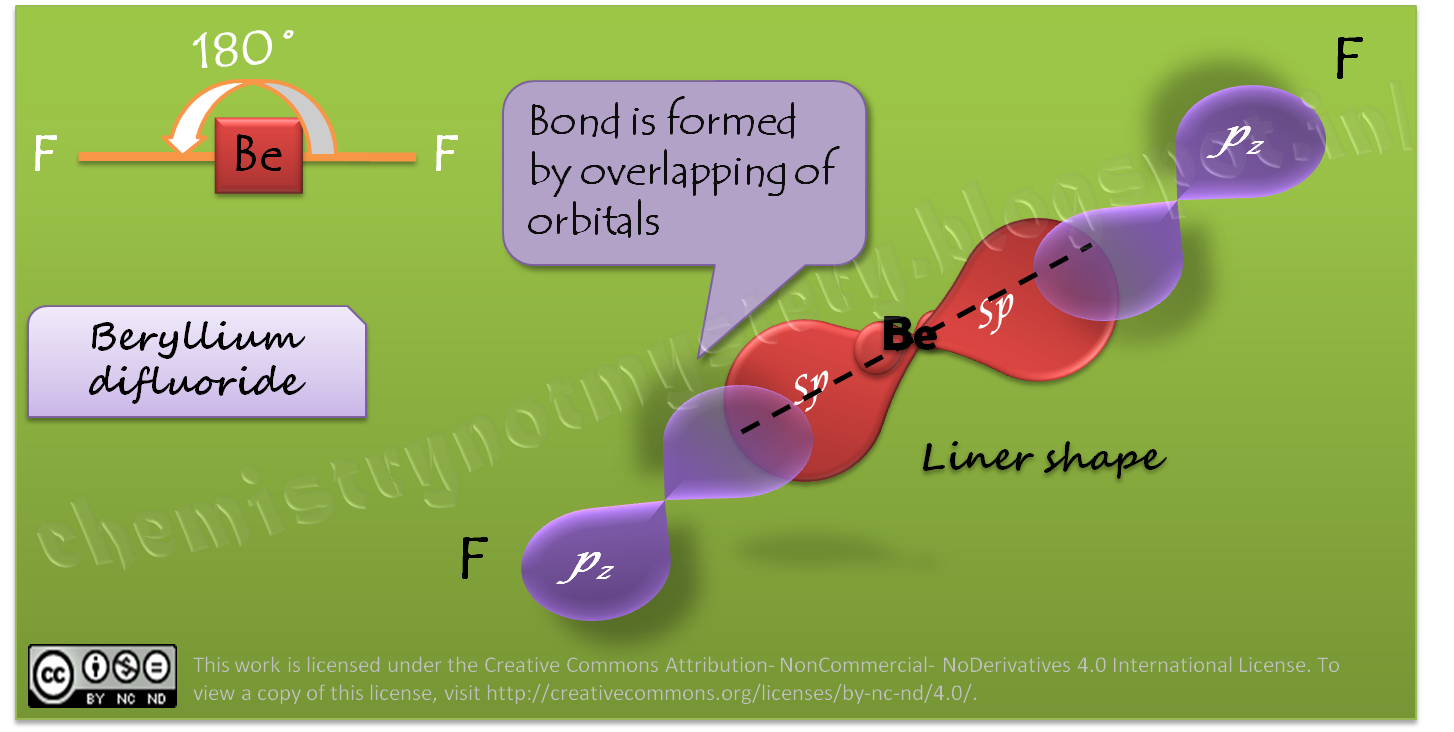
Be has 2 paired electrons but it needs 2 unpaired electrons to combine with unpaired electrons of two atoms of F. Outer orbit of Be has two orbitals s and p so it promotes its one electron to the p orbital. Now it’s excited state configuration will be

2Be – 1s2, 2s1, 2p1

With the promotion of electron, 2s orbital also gets promoted to the level of 2p orbital. Now Be picks ones and one p orbital and hybridises them to get two sphybridised orbitals. These two sphybridised orbitals get arranged in a linear shape.

linear shapeNow two F atoms come closer to Be atom and sp hybridised orbitals of Be andp orbital of F get overlapped with each other and make bonds. Thus BeF2molecule is formed by bonding between sp-p.

Up to now we have discussed those molecules which have single covalent bonds. In previous post of covalent compounds we have seen two more type of covalent bonds double bond and triple bond. How are these bonds formed? You know these bonds are formed by sharing of 4 and 6 valence electrons respectively. What is the role of orbitals in their formation? We will see the sights of orbitals in the formation of double and triple bond in the next post.


This work is licensed under the Creative Commons Attribution- NonCommercial- NoDerivatives 4.0 International License. To view a copy of this license, visit http://creativecommons.org/licenses/by-nc-nd/4.0/.

Friday, August 15, 2014

Hybridization: sp3 hybridization in Methane


We have discussed the formation of CH4 in the last post. We have seen that in CH4  molecule bonds are formed by one s and three p orbitals of C. That means it must have two kinds of bonds, one which is formed by s orbital and the others which are formed by p orbitals of C. But the chemical and physical evidences indicate that it has 4 identical bonds. To solve this mystery scientist proposed the hypothesis (virtual theory) of Hybridization. There are no evidences that it exists but it gives an explanation and it is extensively used in the study of carbon compounds.

Let’s have a look on CH4 molecule again in the light of this hypothesis. Carbon has 1 spherical s orbital and 3 dumbbell shaped p orbitals but it wants 4 identical orbitals so it uses hybridization.

This hybridization is similar to the hybridization you use in your garden, when you hybridise white rose with red rose you get pink rose. Pink rose is a combination of them but is different from them. C applies similar technique to get identical orbitals. But there is a condition that C can hybridize only those orbitals which have similar energy and 2s has lesser energy than 2p. So C supplied some energy to 2s orbital and lifts it to the same level of 2p orbitals. Now it can mix its one spherical 2s and three dumbbell shaped 2p orbitals and get four identical hybridised orbitals named as 
sp3. These hybridised orbitals are equal in energy and identical in shape. Their shape is neither spherical nor dumb-belled but it’s somewhat between them.

Each 
sp3 hybridi​s​ed orbital accommodates unpaired electron of C. These sp3 hybridised orbital arrange themselves in a tetrahedral shape to keeps equal and maximum distance from each other.

H has one unpaired electron in its s orbital. H comes closer to C so that its s orbital and 
sp3 hybridised orbital of C could get overlapped with each other. After overlapping of orbitals they share their electrons and make bonds. Thus CH4 molecule is formed by bonding between four sp3 orbitals of C and s of four H atoms.

Tetrahedral shape

In hybridization we have learnt that:

  • Only the orbitals which have similar energy can be mixed by hybridization.
  • Number of hybridised orbitals is equal to the number of atomic orbitals that participate in hybridization. For example, one s and three p orbitals hybridised to form four sp3 hybridised orbitals.
  • Hybridised orbitals of central atom decide the shape of the molecule.
  • Bonding occurs by overlapping of hybridised orbitals of central atom and the orbital of other atoms.

Let’s take another example of BF3 molecule. Central atom B needs 3 orbitals but it has one s and three p orbitals. In the next post we will see that how does Boron use hybridization to get 3 equivalent hybridized orbitals?


This work is licensed under the Creative Commons Attribution- NonCommercial- NoDerivatives 4.0 International License. To view a copy of this license, visit http://creativecommons.org/licenses/by-nc-nd/4.0/.